Themes are your strategic anchor for content planning
While you’re laying out your content strategy for H2, you already know the details will evolve. Deadlines will shift. Product launches get delayed or moved up. Subject matter experts back out. You discover a channel that works better than expected and need to pivot.
What shouldn’t change are your themes. These are the foundation of your strategic narrative — the throughline that creates cohesion across every piece of content you produce, every channel you publish on, and every stage of the customer journey. Whether someone is a first-time visitor or a long-standing client, they should see a consistent message.
Themes are not topics. A topic is “how to write a case study.” A theme is “proof over promises” — and a case study article is one of many assets that expresses it.
Where themes come from
Ideally, themes come from leadership. They reflect the company’s strategic priorities for the year and give the marketing team a mandate rather than a brief.
In practice, themes often originate in product marketing or the content team and work their way up for sign-off. Either direction can work. What matters is alignment. A theme nobody owns is a theme nobody follows.
The test for a good theme is whether it can generate content ideas at every level of the content funnel. A theme that only produces top-of-funnel awareness content isn’t strategic enough. A theme that only produces bottom-of-funnel conversion content will exhaust your audience. A good theme should be able to anchor a thought leadership piece, an evergreen how-to, a lead gen asset, and a seasonal hook all in the same quarter.
The content types that bring a theme to life
Once you have your themes, the question is how to express them. This is where content type discipline matters.
Most content plans default to the same two or three formats month after month. Blog posts, maybe a white paper, the occasional social carousel. That’s not a strategy — it’s a habit. And it’s one of the main drivers of the content fatigue we wrote about in 7 types of content that keep readers coming back.
A well-structured content plan should include at least five content types working in parallel:
Thought leadership is the rarest and most valuable. One or two pieces per month with a real point of view compounds faster than daily filler. This is the content type most likely to build AI citation authority — because POV-driven content that expresses a specific, defensible argument is what AI assistants surface when prospects ask questions in your category. We covered why this matters in depth in the content mix piece, but the short version is: generic content is invisible to AI engines. Thought leadership is not.
Evergreen and SEO content is the backbone of your content library. How-to posts, strategy explainers, case studies, infographics. Content you can refresh, expand, and re-promote rather than constantly replacing. A well-written and well-designed case study, for example, can anchor your library for years and keep generating leads long after its original publish date.
Lead gen assets are the pieces that drive downloads and list growth. Templates, calculators, white papers, checklists. One strong downloadable per month consistently outperforms four weak ones. The goal is a piece valuable enough that someone will exchange their email address for it. Our social media competitor analysis tool and the editorial theme planner below are examples of this format.
Seasonal and news content covers two distinct needs that often get conflated. Seasonal content is planned — tax season, quarterly earnings, elections, industry conferences. News content is rapid response. They require different preparation but share the same insight: your audience is paying attention to the calendar and the headlines. Meeting them there demonstrates awareness and builds relevance.
Repurposed and reactivated content is the most underused category in most content plans. If a piece performed well, it deserves a second audience. A high-performing blog post becomes a LinkedIn article series. A white paper becomes a sequence of social posts. A case study gets redesigned into a one-pager for the sales team. Repurposing isn’t laziness — it’s compound interest on your content investment.
From theme to asset: the planning hierarchy
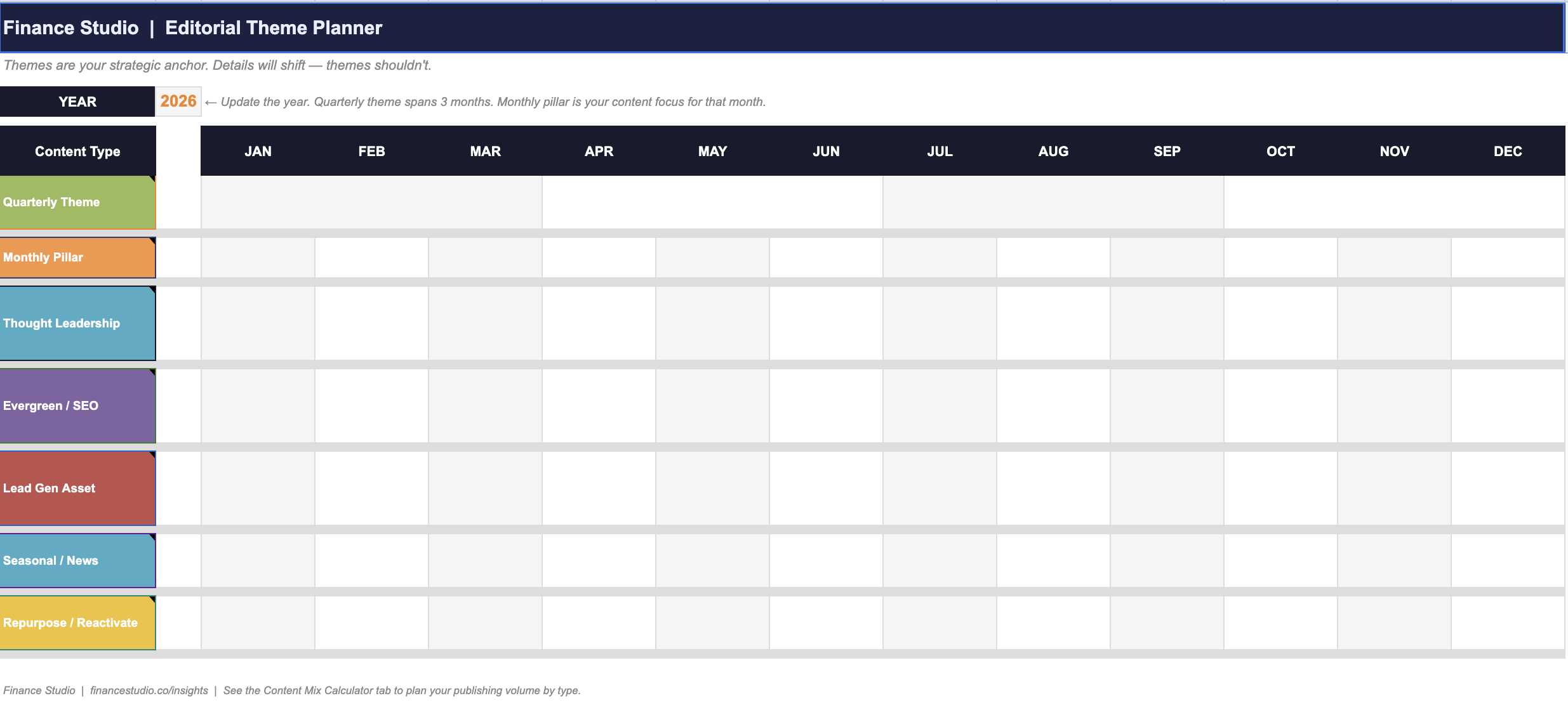
The theme planner works on three levels.
Quarterly themes are your strategic anchor. Four per year, each spanning three months. These come from leadership and should reflect your most important business priorities. “Building trust in uncertain markets.” “Proving ROI in a tighter budget environment.” “Positioning for the AI era.” Each is specific enough to guide decisions but broad enough to generate a full quarter of varied content.
Monthly pillars are the specific angle through which each month expresses the quarterly theme. If the Q1 theme is “Building trust,” January’s pillar might be “transparency in communications,” February’s might be “client proof and case studies,” and March’s might be “consistency as a trust signal.” The pillar gives the content team a specific lens for the month without changing the overall narrative direction.
Assets are the individual pieces that express each monthly pillar across content types. This is where the planner meets the calendar.
Why the content mix matters as much as the themes
Having great themes doesn’t help if all your assets are the same type. A quarter of nothing but thought leadership pieces won’t drive leads. A quarter of nothing but lead gen assets will exhaust your audience’s patience.
The Content Mix Calculator tab in the tool below is designed to solve this. You enter your total planned pieces per month, and it shows you how many of each content type to produce based on recommended ratios. The defaults are based on what tends to work for financial brands — evergreen-heavy, thought leadership consistent, lead gen monthly, seasonal as needed, with room for format variation and repurposing built in.
The ratios are adjustable. A new brand building its content library for the first time should weight evergreen content higher. An established brand with strong authority should shift weight toward thought leadership and lead gen. The calculator includes guidance for both scenarios.
Content planning in the age of AI
Content planning has one new variable in 2026 that didn’t exist just two years ago: AI search visibility.
When you’re deciding which themes to anchor your year around and which evergreen topics to target, it’s worth running a quick check. Ask Claude, ChatGPT, or Perplexity the questions your prospects are most likely to ask. See who appears, in what depth, and with what authority. The gaps in those answers are your best content opportunities — and the themes most worth anchoring a quarter around.
We laid out a full workflow for this kind of competitive intelligence in how to run a social media competitor analysis with Claude. The same prompts that audit your competitors’ social presence can surface the content gaps your themes should be filling.
The download
The Finance Studio Editorial Theme Planner includes two tabs.
The first is the annual calendar — monthly columns across all seven content types, with quarter spans for your strategic themes and monthly pillars. The second is the Content Mix Calculator, where you enter your publishing volume and get a recommended breakdown by content type with rationale for each allocation.
Both tabs are designed to be shared. The planner gives leadership a high-level view of the year’s strategic narrative. The calculator gives the content team a practical brief for how to fill it.
Download the free Editorial Theme Planner – Click FILE > then “Make a copy” > then rename and save to your personal Drive.